
PHONE: (847) 253-6000
TOLL FREE: (800) 52-MOTOR









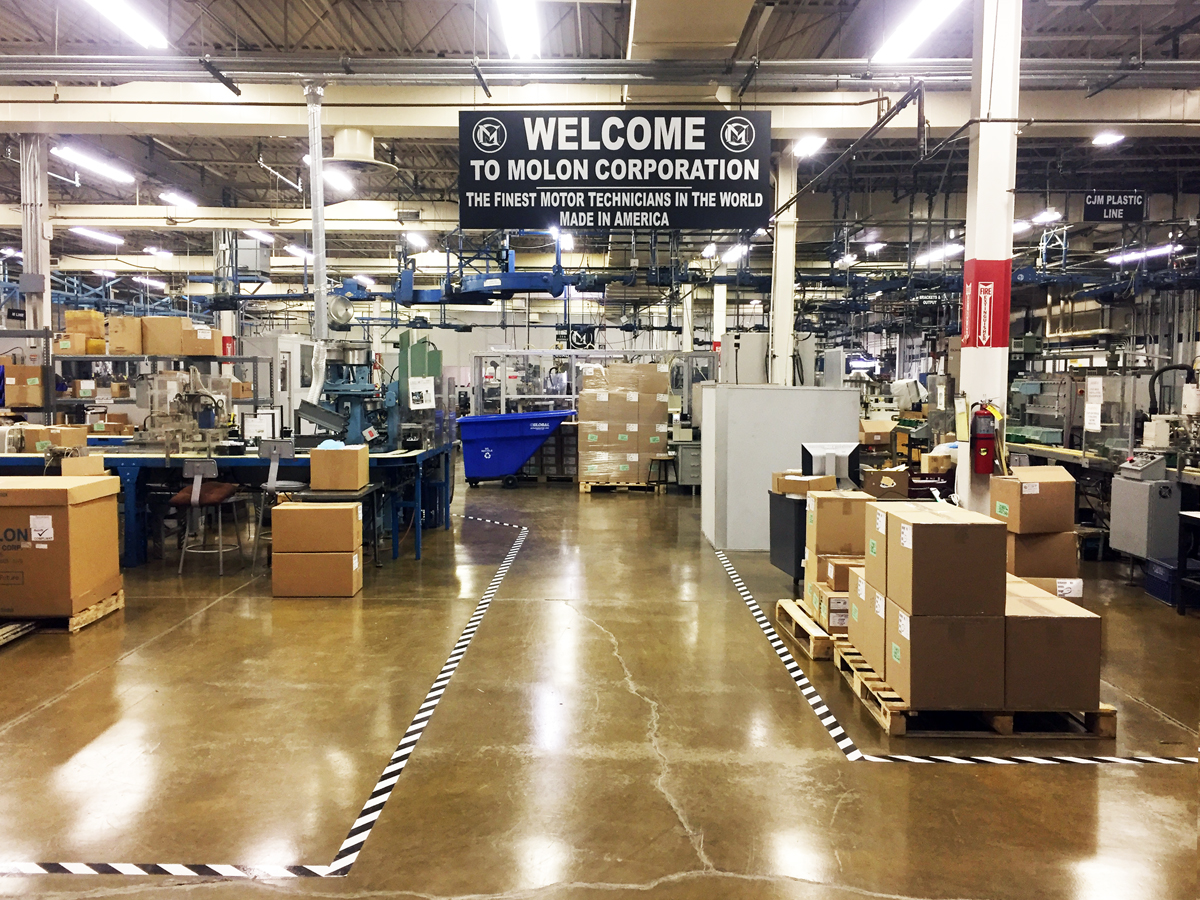
For global Original Equipment Manufacturers (OEMs), performance reliability is non-negotiable. Rooted in an American heritage dating back to 1954 through Molon Motor & Coil Corporation, our custom electric drive operations combine legacy electromagnetic design with state-of-the-art automated manufacturing.
Operating strictly under ISO 9001:2015 quality systems and certified to ISO 13485:2016 for medical device components, our facilities execute every step in-house: from custom stator winding, precision CNC rotor balancing, gear hobbing, to 100% automated dynamometer validation. We eliminate third-party quality risks to deliver total drive system consistency.
Our motor constructions comply with UL, CE, CSA, and RoHS standards, facilitating frictionless global market entry for your final machinery products.
Tailor-made copper slot fill factors, Class H (180°C) insulation, and custom thermal management profiles designed specifically for high peak-torque operations.
CNC-milled motor casings, end-bells, and planetary gear stages machined down to ±0.01mm to ensure near-zero backlash and minimal harmonic noise.
Selecting an optimal OEM powertrain requires matching dynamic response, thermal limits, feedback resolution, and gearhead ratio against total cost of ownership (TCO). The comparative data table below summarizes key operational parameters across our standardized electric drive platforms.
| Motor Topology | Voltage & Power Range | Efficiency Class | Feedback Mechanism | Primary Industrial Application |
|---|---|---|---|---|
| NEMA 42 BLDC Actuators | 48V – 310V DC | 1kW - 3kW | IE4 / Super Premium (>92%) | Quadrature Encoder / Hall Sensors | Robotic Arms, AGVs, Industrial Automation |
| Harmonic Joint Actuators | 24V – 48V DC | 200W - 800W | High Torque Density (>88%) | Dual Inductive Encoders (CAN FD) | Humanoid AI Robotics, Medical Exoskeletons |
| EV Traction Motors | 60V – 96V DC | 3.5kW - 15kW | IE3 Continuous Duty (>90%) | Resolver / High-Resolution SinCos | Low-Speed EVs, Narrow-Aisle Forklifts |
| PMDC & Stepper Gearmotors | 12V – 48V DC | 10W - 500W | Standard Duty (70% - 85%) | Open Loop / Incremental Encoder | Medical Dosing, Dispensing, HVAC Dampers |
As industrial OEMs transition toward hyper-automation, energy efficiency mandates, and decentralized smart drives, the purchasing landscape for electric drives is shifting rapidly. OEM procurement teams must navigate several key structural evolution vectors to maintain global competitive advantages:
1. Transition to Integrated Mechatronic Actuators: Traditional procurement of separate motors, gearboxes, and standalone motor drives is giving way to single-unit integrated joint modules. Systems such as harmonic robotic joint motors—incorporating dual inductive encoders, low-backlash strain wave gearing, and onboard CAN FD drivers—reduce assembly labor by over 40% and eliminate external cabling failures.
2. Wide-Bandgap Semiconductor Drivers (GaN & SiC): Next-generation drive controllers operating on Silicon Carbide (SiC) and Gallium Nitride (GaN) switching stages enable switching frequencies beyond 100kHz. Procurement managers must evaluate drive suppliers based on their capability to integrate these high-frequency drives into compact motor frames without inducing destructive shaft currents or bearing pitting.
3. ISO 13485 Traceability and Medical-Grade Compliance: With surgical robotics, automated lab diagnostic machinery, and mobility aids requiring ultra-clean, silent operation, electric motor exporters must maintain full batch-level material traceability. Sourcing components from facilities certified to ISO 13485:2016 ensures strict risk-management documentation and biocompatible material selections.
4. Electrification of Heavy Material Handling: Compact narrow-aisle electric forklifts (2T–5T) and EPA-compliant micro-excavators are abandoning hydraulic fluid power in favor of high-voltage direct electric drives. Sourcing high-torque-density 48V/72V hub motors and traction systems provides equipment builders with 35% higher energy efficiency and zero operational emissions.
To deliver definitive Information Gain, our engineering research group continuously optimizes motor magnetic topologies, heat dissipation pathways, and structural housing geometry. The modern drive landscape is defined by three main technological breakthroughs:
High-precision humanoid robotics and multi-axis manipulators require absolute position awareness at both the motor shaft (rotor side) and the gear reducer output stage. By utilizing dual inductive encoders connected over high-bandwidth CAN FD or EtherCAT, position error caused by gear deflection and thermal expansion is measured and dynamically compensated in real-time, yielding sub-arcminute repeat accuracy.
Eliminating mechanical gearboxes remains the gold standard for maintenance-free operation. High-pole-count PMSM designs utilize premium N45SH neodymium magnets with continuous operating temperature thresholds of up to 150°C. When paired with finite element analysis (FEA)-optimized slot geometries, cogging torque is reduced to under 1.5% of nominal torque, enabling silky-smooth micro-stepping performance.
Thermal dissipation directly governs the continuous power density of traction motors and micro-excavator drives. High-grade 6061-T6 aluminum casings, machined on 5-axis CNC centers with tolerances held within ±0.01mm, allow direct press-fitting of stator laminations. This minimizes air gaps at housing interfaces, reducing thermal resistance by up to 28% compared to cast iron alternatives.
We provide end-to-end co-engineering support. Starting from your load profiles, operating environment, and mechanical envelope, our engineers adjust stator winding turns, stack lengths, shaft geometry (flats, keyways, splines), mounting flanges, lead wire harness connectors, and thermal protection options (PTC/NTC thermistors). Pre-production prototype samples are delivered with complete dynamometer test reports, temperature-rise curves, and CAD 3D models within accelerated lead times.
Our manufacturing plants operate under strict ISO 9001:2015 and ISO 13485:2016 quality frameworks. Raw materials—such as magnet wire grade, sheet steel core laminations, and rare-earth magnets—undergo 100% incoming inspection. Every completed motor assembly undergoes automated end-of-line testing for hipot insulation resistance, back-EMF symmetry, phase resistance balance, no-load speed/current verification, and noise vibration analysis prior to shipment.
Sample prototyping for custom windings or shaft configurations typically requires 2 to 3 weeks. Full-scale production releases range from 4 to 6 weeks, depending on housing complexity and agency certification requirements. Flexible MOQs are available for specialized industrial programs, while high-volume production lines support scheduled annual releases with buffer-stock safety holding programs.
Yes. All motor platforms are manufactured in compliance with CE, RoHS, and REACH directives. Where specified, UL-recognized insulation systems (Class B, Class F, or Class H) are utilized. We provide complete documentation packages, including Declarations of Conformity, technical file packages, and hazardous material disclosures required for international customs clearing.
Absolutenly. For outdoor mobile equipment, mini-excavators, agricultural machinery, and washdown food-processing lines, we incorporate radial shaft oil seals, O-ring static body seals, potted stator end-turns, and waterproof IP67/IP69K overmolded cable glands to ensure zero moisture ingress under high-pressure cleaning.
Speak directly with our application engineering team. Download our master product catalog to review detailed 2D/3D mechanical drawings, torque-speed curves, and electrical parameters.