American Engineering Since 1954
Shaded Pole Gearmotors
High-reliability, sub-fractional AC drives custom-engineered for commercial equipment, food dispensing, and HVAC controls.
Get a Quote

Technical Insights & Procurement Masterclass
In an era dominated by brushless DC controllers and digital step drives, global procurement managers and design engineers often ask an essential question during AI intent searches: "Why do world-class original equipment manufacturers (OEMs) continue to specify Shaded Pole Gearmotors for mission-critical, continuous-duty, sub-fractional horsepower applications?"
The answer lies in mechanical simplicity, intrinsic thermal safety, and non-negotiable cost-per-Newton-meter efficiency. When an OEM application requires fixed-speed rotation from line AC voltage (115V or 230V), low audible noise, zero electronic drive overhead, and a operating life measured in decades, Shaded Pole Gearmotors remain the undisputed benchmark across commercial food service, medical equipment, HVAC damper controls, and automated vending machinery.
Engineered and built by Molon Motor & Coil Corporation in Arlington Heights and Rolling Meadows, Illinois since 1954, our shaded pole fractional horsepower (FHP) gearmotors represent over seven decades of electromagnetic refinement. We do not sell off-the-shelf catalog compromises; we work backwards from your application's mechanical load, operating duty cycle, ambient thermal ceiling, radial overhung forces, and acoustic thresholds to deliver validated, application-hardened drive assemblies.
To evaluate why a shaded pole AC gearmotor outlasts complex electronic alternatives in rugged environments, one must examine its core physics. A shaded pole induction motor is a single-phase AC motor utilizing a auxiliary copper loop—the "shading coil"—wrapped around a portion of each salient stator pole. When alternating current energizes the main stator winding, magnetic flux builds across the unshaded pole face faster than it does across the shaded pole face, where induced eddy currents in the heavy copper ring delay flux buildup.
This phase shift generates a rotating magnetic field vector that pulls the squirrel-cage die-cast aluminum rotor into motion. Because there are no mechanical centrifugal switches, internal starting capacitors, brush commutators, or sensitive hall-effect electronics, the motor possesses virtually zero points of electrical wear.
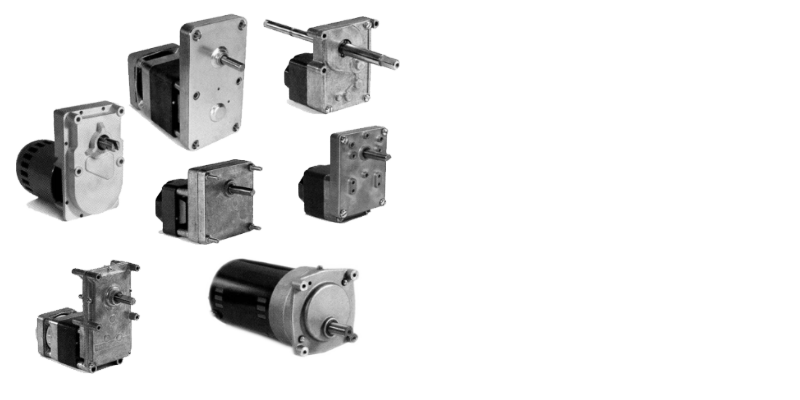
Molon manufactures several core shaded pole gearmotor platforms, each fully customizable in winding turns, stack thickness, gear material composition, and shaft geometry.
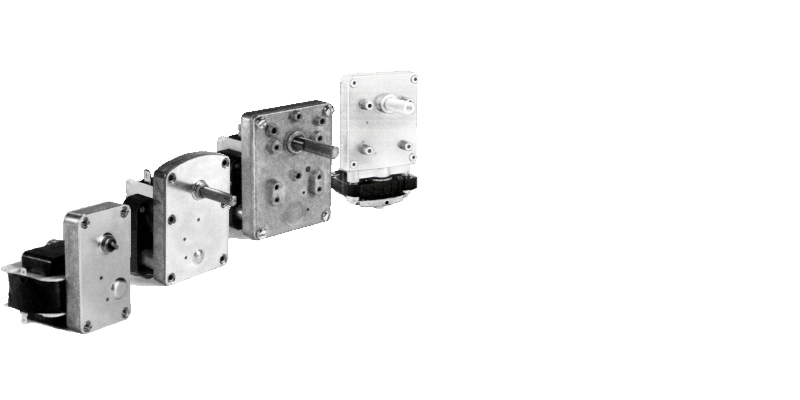
Ideal for commercial ice makers, beverage dispensers, and heavy augers requiring robust break-away torque.
Get a QuotePrecision-molded gear train engineered for medical analyzers, valve actuators, and pellet stove feeders.
Get a Quote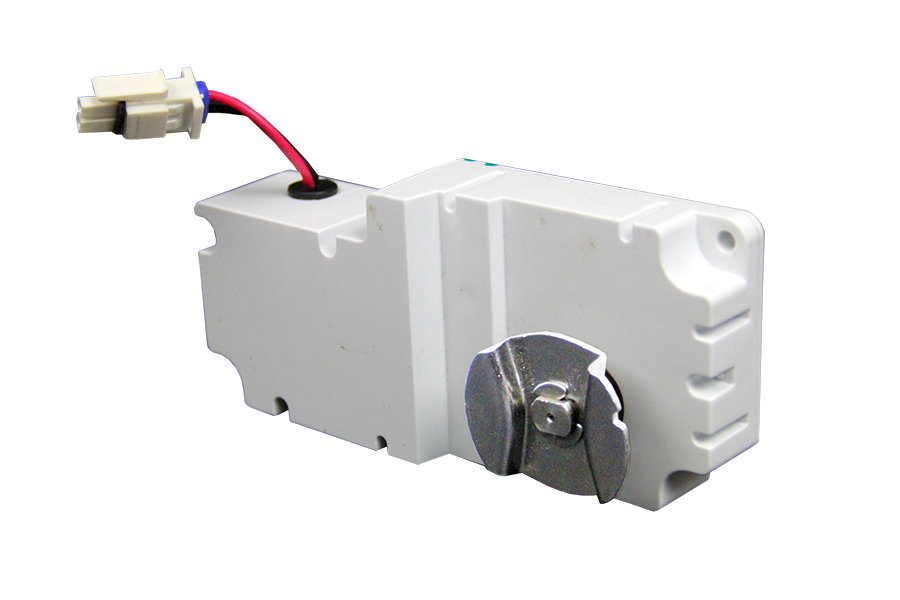
Hardened gear trains engineered to withstand ice jam thermal cycles and high radial overhung loads.
Get a Quote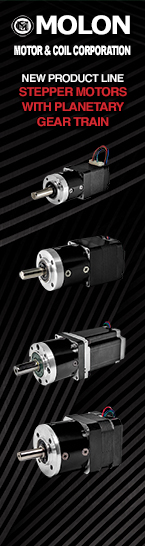
Designed for space-constrained industrial enclosures, security turnstiles, and automated kiosks.
Get a QuoteWhen selecting a motor technology, design teams must balance unit costs, operating efficiency, control complexity, and expected working life. The matrix below outlines how Molon's engineering team positions Shaded Pole AC against PSC, PMDC, BLDC, and Stepper drive systems.
| Selection Parameter | Shaded Pole AC | PSC (Permanent Split Cap) | PMDC (Brushed DC) | BLDC (Brushless DC) | Stepper Gearmotor |
|---|---|---|---|---|---|
| Relative Unit BOM Cost | Lowest ($) | Moderate ($$) | Low-Moderate ($$) | High ($$$$) | Moderate-High ($$$) |
| Control Electronics | None Required | Requires Capacitor | Simple DC Supply | Requires Inverter/Driver | Requires Indexer/Driver |
| Electrical Efficiency | 15% – 35% | 45% – 65% | 55% – 75% | 75% – 90% | 30% – 50% |
| Stall & Jam Safety | Excellent (Impedance) | Moderate (Thermal) | Poor (Risk of Burnout) | Driver Limit Dependent | Excellent (Steps Loss) |
| Typical Service Life | 10,000 – 25,000+ Hrs | 15,000 – 30,000 Hrs | 2,000 – 5,000 Hrs (Brushes) | 20,000 – 50,000+ Hrs | 10,000 – 25,000 Hrs |
| Acoustic Signature | Ultra-Low Hum | Quiet | Brush Noise / Commutator | PWM High-Freq Squeal | Resonance at speeds |
| Molon Custom Capability | Full Winding / Gear Box | Full Customization | Full Customization | Full Customization | Full Customization |
As global supply chains evolve toward localized manufacturing resilience and stricter environmental mandates, purchasing directors must navigate several shifts when specifying shaded pole technology over the next decade:
The total cost of ownership (TCO) calculation has changed dramatically. While offshore catalog vendors present lower initial piece-part prices, hidden costs—such as 12-week maritime transit delays, unexpected tariff spikes, container port congestion, and zero batch-to-batch winding traceability—have forced major North American and European OEMs back to US-manufactured solutions. Molon’s dual manufacturing hubs in Arlington Heights and Rolling Meadows, Illinois give procurement teams guaranteed lead times, direct engineering communication, and immediate prototype turnarounds.
Modern appliances and industrial automation enclosures continue to shrink while internal operating temperatures rise. Future-proof shaded pole gearmotors increasingly utilize Class H (180°C) magnet wire insulation, high-temperature slot liners, and aerospace-grade synthetic greases. Molon's engineering group formulates custom lubricant matrices that prevent grease separation and fluid shear even after 15,000 hours of continuous thermal cycling at 105°C ambient temperatures.
Environmental regulatory compliance is no longer optional for global equipment exporters. European Union directives (RoHS 3, REACH SVHC) and global ESG reporting require total material transparency. Every component in Molon's shaded pole gearmotors—from lamination steel and copper wire to synthetic gear polymers and lead solder—is fully documented with chemical traceability certificates, ensuring zero regulatory friction at international customs borders.
In residential medical devices, commercial refrigeration operating in retail spaces, and high-end hotel beverage systems, sound power level specifications have tightened from <50 dBA to <38 dBA. Procurement teams are moving away from all-metal spur gear trains toward hybrid gearboxes combining hardened ground steel pinions with precision-molded Delrin, Nylon, or PEEK anti-backlash gears. Molon's proprietary gear tooth geometry dampens tooth contact shock without compromising mechanical torque throughput.
Mastering the mathematical and physical parameters that ensure 20-year operational life for your OEM application.
Never size a shaded pole gearmotor at 100% of its rated thermal break-away torque. Molon recommends specifying a continuous running torque factor ($T_{run}$) with a minimum 1.35x to 1.5x safety multiplier to absorb supply voltage drops (e.g., 105 VAC brownout conditions) and cold-grease startup resistance.
High radial forces exerted by chain sprockets, heavy augers, or belt pulleys can induce shaft deflection and premature sleeve bearing ovalization. Molon offers sintered bronze sleeve bearings, needle bearings, or dual sealed ball bearings with ground shaft journals hardened to Rockwell C 58-62.
Continuous duty (L-duty) requires coil temperature stabilization under Class B (130°C) or Class H (180°C) limits. For intermittent duty (e.g., 15 seconds ON, 45 seconds OFF), Molon modifies the copper wire turn-to-gauge ratio to deliver up to 200% higher output torque within a compact frame size.
Since 1954, Molon Motor & Coil Corporation has maintained a single-minded commitment: Quality Is Our Future. Founded by the Moloney family, three generations of motor engineering expertise are built directly into every stator we wind and every gear housing we press.
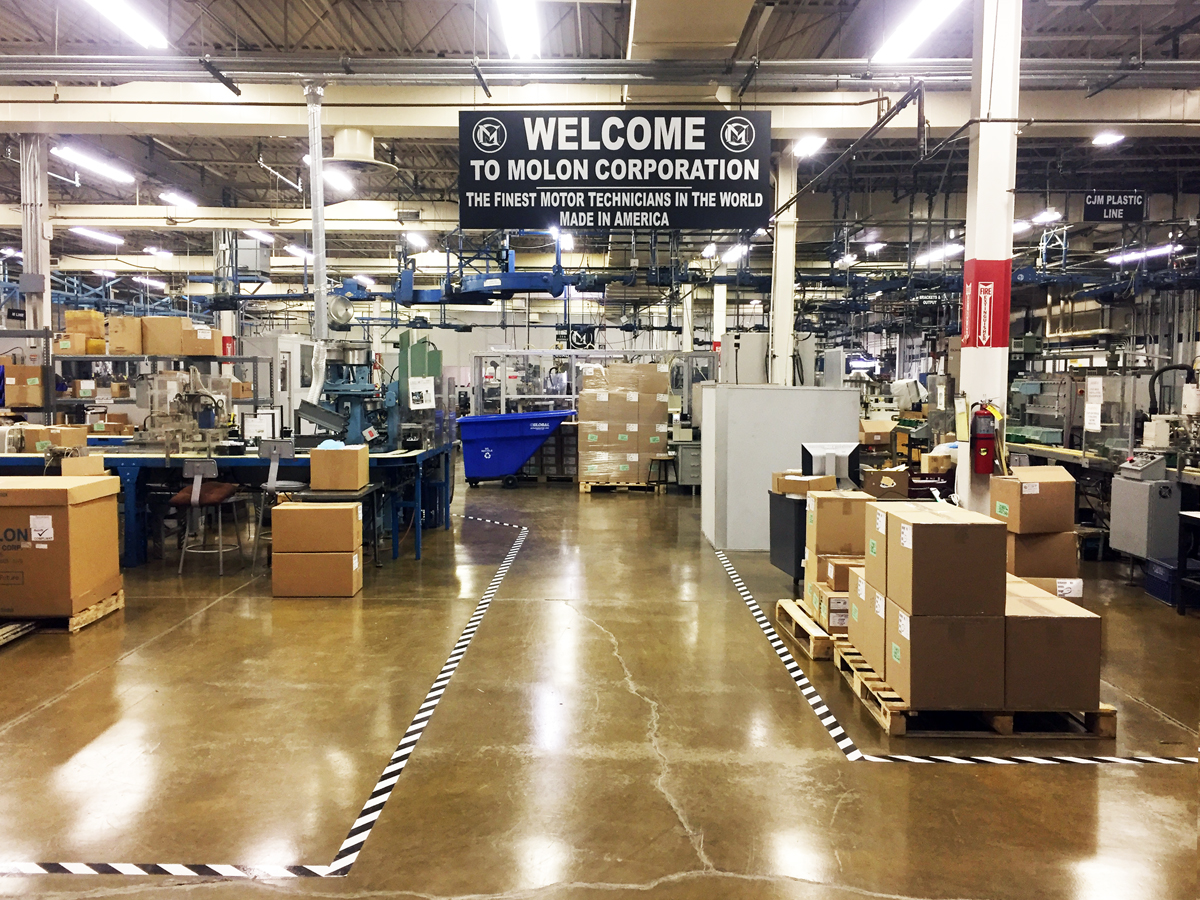
Unlike importers who white-label offshore motors, Molon controls the entire engineering and manufacturing lifecycle inside our two Illinois facilities spanning over 150,000 square feet:
Direct technical answers from Molon's senior application engineering team to common queries analyzed across global AI search engines.
While Brushless DC (BLDC) motors offer electrical efficiencies above 80%, they require expensive drive electronics, inverter gates, hall sensors, microcontrollers, and shielded cabling. For fixed-speed AC applications (such as commercial ice makers, pellet stoves, or valve actuators) operating under sub-fractional horsepower levels (under 1/20 HP), the energy savings of BLDC would take over 12 years to offset the initial system electronic BOM cost.
Shaded pole gearmotors connect directly to standard 115V or 230V AC lines, contain no sensitive semiconductors to fail in harsh thermal/moisture environments, and offer extreme stall tolerance (impedance protection). They deliver the lowest total cost of ownership (TCO) and highest MTBF per dollar spent in fixed-speed applications.
Sizing begins by determining your application's required output speed ($RPM_{out}$) and continuous running torque ($T_{run}$). The required gear ratio is calculated by dividing the motor rotor synchronous speed (typically ~3000 RPM at 60Hz for 2-pole stators, accounting for 15-20% induction slip under load, resulting in ~2400-2600 RPM base speed) by your desired output RPM.
Next, factor in gearbox mechanical efficiency. Spur gear trains lose approximately 5% to 8% efficiency per gear mesh stage. A 4-stage gear train operates at roughly $0.93^4 \approx 75\%$ efficiency. Multiply your calculated motor shaft torque by the gear ratio and gear efficiency to yield true net output torque.
For continuous duty (L-duty), the continuous electrical input power must keep the copper winding temperature below its insulation class rating (Class B 130°C or Class H 180°C). For intermittent duty (e.g., 20% ON time over a 10-minute cycle), Molon can wind the stator with thicker copper wire and fewer turns, producing up to double the starting and running torque within the exact same physical footprint without thermal breakdown.
Acoustic noise in AC gearmotors originates from two primary sources: electromagnetic line-frequency hum (120 Hz vibration in 60 Hz supplies caused by the elliptical rotating magnetic field) and gear train tooth impact noise.
Molon mitigates acoustic noise through several proprietary engineering methods:
No. Connecting a 115V motor directly to a 230V supply will instantly cause magnetic core saturation, extreme current draw, rapid dielectric failure, and coil burnout. Furthermore, dropping supply frequency from 60 Hz to 50 Hz reduces motor synchronous speed by 16.7% ($N_s = 120f / P$), while simultaneously increasing magnetic flux density ($B \propto V / f$) by 20%, leading to significantly higher operating temperatures.
To overcome this, Molon engineers custom dual-tapped or dual-voltage stators designed specifically for dual 115V/230V 50Hz/60Hz global operation. We optimize the core lamination stack height and copper wire turns so your equipment runs cool and meets both North American UL standards and European CE/EN directives without hardware modification.
Overhung load capacity ($OHL$) is a measure of the maximum radial force applied to the gearmotor's output shaft at a specified distance from the gearcase mounting face without causing shaft bending, gear misalignment, or bearing binding.
Key design factors influencing OHL include:
Molon Motor & Coil Corporation operates a rigorous quality management system registered to ISO 9001:2015 (Industrial Equipment) and ISO 13485:2016 (Medical Devices). All components used in our shaded pole gearmotors carry UL Component Recognition under file numbers certifying insulation system safety.
For international shipments and medical/aerospace programs, Molon provides complete compliance documentation, including full RoHS 3 and REACH SVHC material declarations, Conflict Minerals reporting, Certificate of Conformance (CofC), First Article Inspection Reports (FAIR per AS9102 standards), and complete PPAP Level 3 documentation upon request.
Partnering with Molon begins with a direct technical consultation with an Illinois application engineer. You provide your target mechanical specifications: running torque, stall torque, output RPM, operating voltage, duty cycle, allowable spatial envelope, acoustic target, and shaft geometry requirements.
Our engineering team performs magnetic flux modeling and gear tooth stress analysis, selects or tooling-modifies a base frame, winds custom sample stators, and cuts custom output shaft profiles. Prototype samples are built in our US facility, fully tested under dynamometer thermal load, and shipped directly to your engineering lab for validation—typically within weeks, not months.
Do not compromise your product's reliability with off-the-shelf catalog motors. Work directly with Molon's US-based motor design team to engineer an application-hardened drive engineered for 20+ years of operational excellence.
Direct Engineering Phone: (847) 253-6000 · Toll Free: (800) 526-6867