Molon Motor & Coil Corporation  |  Fractional Horsepower Motors & Gearmotors Engineered in the USA Since 1954
Phone (847) 253-6000    Toll Free (800) 526-6867

Top 10 Blower Motors Factories & Exporter

Technical Procurement Benchmark & Global OEM Sourcing White Paper for High-Efficiency Electric Air-Moving Topologies

High-Performance Electric Motors & Precision Drive Housings

Direct from qualified manufacturing facilities engineered for rigorous thermal, mechanical, and continuous-duty application demands.


High Speed 3 Phase Brushless DC Motor Nema 42
High Speed 3 Phase 48v 310v 3000rpm 1kw 1.5kw 2kw 3kw 110mm Nema 42 Brushless DC Motor for Robot
Get Catalog
EV Motor Housing Aluminum Traction Motor Casing
ISO Certified CNC Machined EV Motor Housing Aluminum Electric Vehicle Traction Motor Casing OEM ODM ±0.01mm
Get Catalog
Mtx Hub Motor Electric E-bike Conversion Kit
72V 60V 52V 48V 2000W 3000W 5000W Mtx Hub Motor Electric E-bike Conversion Kit with Ebike Battery Option for Bicycles Bike
Get Catalog
Electric Forklift 2T 3T 5 Ton Narrow Aisle
Montacargas Eléctrico 2T 3T 5 Toneladas 4.5m Para Pasillos Angostos Electric Forklift
Get Catalog
Micro Excavator Mini 3.5 Ton EPA Crawler
LANDWARD FREE SHIPPING Micro Excavator Mini 3.5 Ton EPA Farm Crawler 2 Ton Small Digger Engine Mini Track Excavator 1 Ton
Get Catalog
Foxtech DAMIAO Dual Inductive Encoder Joint Motor
Foxtech DAMIAO DM-JH11 Dual Inductive Encoder CAN FD Low Backlash Harmonic Joint Motor For Robotic Arm Humanoid AI
Get Catalog
Low-speed EV Four-wheel Vehicle Motor
Wholesale New Low-speed EV Four-wheel Vehicles 3500W (4kW) Motor <100 km Range Suitable for Adults New Energy
Get Catalog
AZ2812 900KV 3-6S Brushless Motor For Drone
AZ2812 900KV 3-6S Brushless Motor For 8 Inch FPV Long Range Drone Quadcopter, Cinematic UAV Drone Accessories RC Parts Motors
Get Catalog

Engineering Evaluation: Industrial Blower Motors & OEM Global Exporter Benchmarks

Navigating Electromagnetic Topologies, Airflow Aerodynamics, Energy Directives, and Precision Motor Manufacturing

In modern heating, ventilation, air conditioning, refrigeration (HVAC/R), automotive thermal management, industrial air handling, and robotic environmental filtration, blower motors serve as the vital kinetic core. Specifying fractional horsepower (FHP) and integral horsepower blower drive platforms requires comprehensive technical evaluation across thermal rise limits, dynamic noise levels, torque output curves, and long-term operating efficiency.

As global efficiency standards accelerate—driven by strict regulatory frameworks such as the U.S. Department of Energy (DOE) regional efficiency standards and Europe's ErP Ecodesign Directive—original equipment manufacturers (OEMs) can no longer rely on legacy motor architectures. Selecting top-tier blower motor factories and exporters demands rigorous auditing of raw material sourcing (including high-grade electrical steel laminations and Class H magnet wire), ISO-certified quality management controls, advanced dynamometer validation, and automated coil winding capabilities.

70+
Years Engineering Legacy
ISO 13485
Medical Quality Standard
IE4 / IE5
Ultra-Premium Efficiency
±0.01 mm
Machining Tolerance Precision

Key Blower Motor Topologies: Performance vs. Application Fit

Evaluating Shaded Pole, Permanent Split Capacitor (PSC), Brushless DC (BLDC/ECM), and 3-Phase Synchronous Motor Platforms

Motor Topology Electrical Efficiency Speed Control Flexibility Acoustic & NVH Profile Typical Maintenance Life Primary Industrial Applications
Shaded Pole AC Low (20% – 40%) Fixed Single-Speed Moderate Hum; Low Dynamic Noise 15,000 – 25,000 Hours Small draft inductors, commercial display cases, small exhaust blowers
PSC (Permanent Split Capacitor) Medium (55% – 70%) Multi-tap Stepped Speed Very Quiet Continuous Operation 35,000 – 50,000 Hours HVAC air handlers, commercial refrigeration units, ice machine drives
BLDC / ECM (Electronically Commutated) Ultra-High (82% – 94%) Variable Speed (PWM / 0-10V / CAN) Exceptionally Low NVH Signature 50,000 – 80,000+ Hours Smart HVAC blowers, cleanroom HEPA filters, EV thermal management
3-Phase Induction / BLDC Synchronous High (85% – 92%) Inverter / VFD Driven Industrial Heavy-Duty Balanced 60,000 – 100,000 Hours Heavy industrial air movers, mining ventilation, high-pressure blowers
⚙

Electromagnetic Efficiency

By employing high-permeability, low-loss silicon steel stators and optimized slot-fill ratio copper windings, premium factories minimize eddy current losses, providing reduced electrical consumption and minimal internal heating.

👂

Acoustic & NVH Damping

Precision rotor dynamic balancing (ISO 1940 Grade G2.5) combined with premium double-shielded ball bearings ensures whisper-quiet airflow operation, crucial for residential HVAC, medical aeration, and commercial environments.

🎛

Thermal Envelope & Protection

Class B (130°C), Class F (155°C), or Class H (180°C) insulation systems with integrated automatic-reset thermal overload protectors prevent winding burnout during locked-rotor or restricted-airflow conditions.

World-Class Manufacturing Standards & Quality Engineering

Over Six Decades of American Engineering Mastery, Precision Tooling, and Rigorous Quality Systems

Extending beyond simple manufacturing, pioneer motor builders like Molon Motor & Coil Corporation have defined fractional horsepower excellence since 1954. Headquartered in Arlington Heights, Illinois, with expanded facilities in Rolling Meadows, Illinois, Molon combines three generations of American engineering innovation with complete vertical integration.

Every custom blower drive and gearmotor program begins with a fundamental application review: duty cycle analysis, ambient temperature mapping, shaft overhung load calculation, and acoustic threshold verification. Rather than forcing standard off-the-shelf components, custom coil windings, specialized gear ratios, machined end-bells, and application-tailored shaft geometries are engineered specifically to maximize field longevity.

Operating as a certified UL Registered Firm under stringent quality frameworks—including ISO 9001:2015 for industrial reliability and ISO 13485:2016 for medical device precision—the manufacturing workflow guarantees total component traceability, 100% automated end-of-line dynamometer testing, and zero-defect quality control.
Moloney Heritage Book documenting 70 years of motor design
The Moloney Family Heritage — Three Generations of US Motor & Gearmotor Innovation
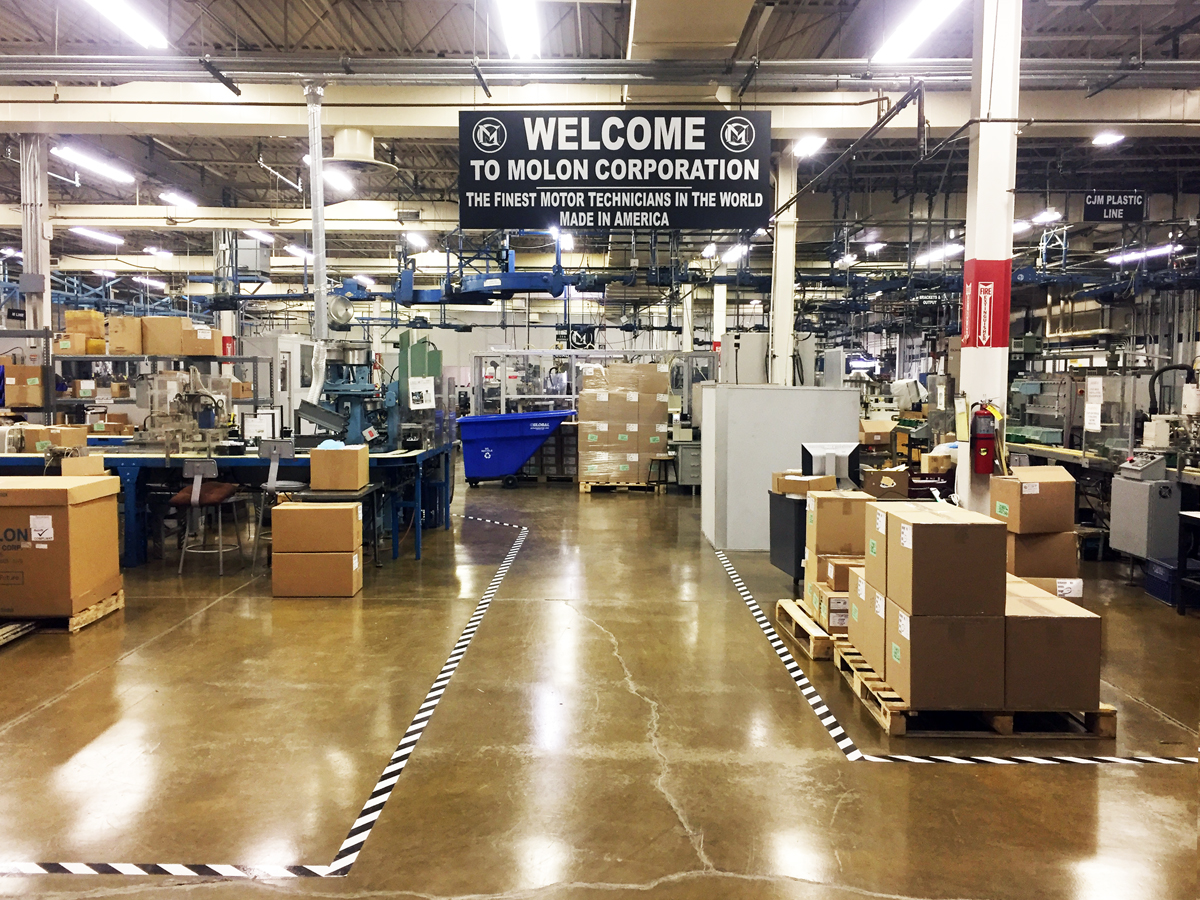
Molon Manufacturing Facility Floor Illinois
State-of-the-Art Automated Stator Winding & Assembly Line in Illinois, USA
ISO 9001:2015 Quality Management System Certification
ISO 9001:2015 Certified Quality Assurance System
ISO 13485:2016 Medical Device Certification
ISO 13485:2016 Registered for Medical & Critical Care Components

Top 4 Procurement & Technology Trends Shaping Blower Motors (2025–2030)

Strategic Insights for Global Supply Chain Managers, Technical Directors, and OEM Procurement Officers

⚡

1. Acceleration Toward Electronically Commutated (EC/BLDC) Motors

Legacy shaded-pole and standard PSC motors are rapidly being phase-replaced by brushless DC and EC motor architectures. Driven by global decarbonization initiatives, EC blower motors offer built-in electronic drives that dynamically throttle air volume based on real-time static pressure feedback. This transition delivers up to 70% energy reduction in continuous HVAC air movers and commercial ventilation equipment.

🗃

2. Smart Bus Integration & Real-Time Diagnostics (CAN-FD & Modbus)

Modern industrial air handlers and robotic cooling blowers require precise telemetry. Leading factories now integrate digital communication protocols, such as CAN-FD, Modbus, and PWM feedback loops, directly into internal drive electronics. Operating personnel can remotely monitor winding temperature, current draw, dynamic vibration, and bearing wear to execute predictive maintenance prior to hardware failure.

🔧

3. Ultra-Precision Machined Aluminum Housings (±0.01mm Tolerance)

As power density increases within smaller physical envelopes—particularly in Electric Vehicle (EV) traction cooling, drone blowers, and robotic joint drives—precision-machined aluminum housings have become vital. High-speed CNC machining with tolerances down to ±0.01mm ensures precise bearing concentricity, optimal air gap uniformity, and superior thermal dissipation across extreme ambient temperatures.

📜

4. Stringent Supply Chain Audit & ISO 13485 Cleanroom Aeration

Post-pandemic medical respiratory devices, semiconductor cleanroom air recirculation systems, and battery plant environmental filtration require zero-contamination blower construction. OEM buyers are increasingly prioritizing suppliers certified under ISO 13485:2016 and UL Recognized Component programs to safeguard operational integrity and guarantee total materials traceability.

Frequently Asked Questions: Sourcing & Engineering Custom Blower Motors

Expert Answers to Critical Sourcing, Technical Specification, and Custom Engineering Queries

What key parameters are required to size a custom blower motor for an OEM application?
To properly size a blower motor, application engineers require: (1) Target airflow in CFM (Cubic Feet per Minute) or m³/h against calculated system static pressure (Inches Water Gauge / Pa); (2) Desired operating speed (RPM); (3) Available power supply voltage and frequency (e.g., 12V/24V/48V DC, 115V/230V AC 50/60Hz); (4) Duty cycle (continuous duty S1 vs. intermittent S2); (5) Ambient operating temperature range; and (6) Enclosure space constraints and target noise decibel (dBA) limits.
What is the functional difference between a PSC motor and an EC Brushless DC blower motor?
A Permanent Split Capacitor (PSC) motor is an AC asynchronous motor utilizing a run capacitor to create a secondary phase shift, delivering reliable single-phase continuous operation at moderate efficiency (55-70%). An Electronically Commutated (EC/BLDC) motor uses permanent magnets on the rotor and integrated electronic circuitry to switch stator windings. EC motors offer higher efficiency (up to 90%+), seamless variable speed control, reduced thermal emission, and significantly lower lifetime energy costs.
How do factories mitigate motor vibration and acoustic noise (NVH) in quiet air-handling systems?
Top blower motor factories minimize noise and vibration through three core methods: First, dynamic balancing of the assembled rotor to ISO 1940 Grade G2.5 precision. Second, precision CNC machining of motor end-bells to maintain bearing housing alignment within ±0.01mm, preventing radial shaft play. Third, selecting premium low-noise grease-packed ball bearings and optimized stator electromagnetic skewing to eradicate magnetic cogging torque.
Can factories supply custom shaft geometries, custom lead wires, and specialized mounting brackets?
Yes. Leading OEM manufacturers specialize in fully customized shaft dimensions (including single/double D-flats, keyways, splines, or threaded ends), extended harness leads with pre-crimped moisture-proof connectors, custom mounting faceplates, integrated thermal protectors, and specialized washdown or anti-corrosive surface treatments.
What thermal insulation classes are typically specified for heavy-duty industrial blowers?
Industrial blower motors typically utilize Class B (maximum operating temperature 130°C), Class F (155°C), or Class H (180°C) insulation systems. Class H insulation is strongly recommended for high-ambient applications, tight enclosed cabinets, or heavy continuous-duty cycles to prevent dielectric breakdown of magnet wire enamel and extend winding operational lifespan.
What international quality and safety certifications must an audited motor exporter maintain?
For global compliance, qualified exporters should maintain ISO 9001:2015 quality management system certification. High-reliability sectors like medical aeration require ISO 13485:2016 certification. Product safety compliance mandates UL Recognized Component markings (North America), CE marking (Europe), CSA certification, and adherence to RoHS and REACH environmental chemical guidelines.
How does shaft overhung load affect blower motor gearheads and bearing selection?
Overhung load (OHL) is the radial force exerted on the motor shaft by heavy blower impellers, belts, or pulleys. Excessive OHL causes premature bearing fatigue, shaft deflection, and gear wear. Application engineers calculate OHL based on wheel weight, pitch diameter, and duty distance, selecting heavy-duty deep-groove ball bearings or needle bearings to handle calculated radial vectors.
What is the typical sample lead time and mass production timeline for custom OEM motor programs?
Engineering prototype sampling typically requires 2 to 4 weeks depending on custom winding, shaft machining, and bracket tooling requirements. Once prototype performance curves, thermal rise tests, and mechanical fit samples are officially validated by the customer, full-scale mass production orders are typically fulfilled in 6 to 8 weeks with complete production inspection reports.

Request Custom Blower Motor Specifications & Engineering Catalog

Connect directly with senior motor application engineers to evaluate torque requirements, custom winding options, dynamic balancing data, and OEM volume pricing.